Spirit & Reason by Vine Deloria Jr. & Kristen Foehner & and Sam Scinta
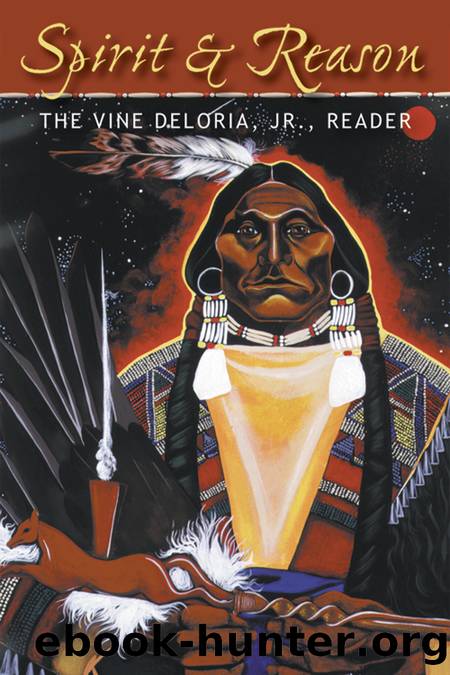
Author:Vine Deloria Jr. & Kristen Foehner & and Sam Scinta
Language: eng
Format: epub
Publisher: Fulcrum Publishing
Published: 2012-08-29T16:00:00+00:00
16
Why Indians Aren’t Celebrating the Bicentennial
Bicentennial planners are shocked that American Indians are not wildly enthusiastic about the coming anniversary of the United States. In some states there have been angry protests against the committees responsible for the various events, and the focus of the national concerns has been blunted by the refusal of many Indians of national prominence to involve themselves in determinations concerning the celebration.
The undercurrent against Indian involvement in the bicentennial is probably strongest in the traditional Indian communities who have never felt themselves a part of the American system. Their alliance in recent years with the younger activists has been based on a demand for enforcement of treaty rights, and certainly many traditionalists share with the activists a mistrust of the federal government that runs so deep as to preclude even consideration of a role in the anniversary celebration. This development is particularly unfortunate because at the turn of the century the traditional chiefs considered themselves such a part of America that they participated in several presidential inaugurations, particularly that of Theodore Roosevelt.
The activists’ ideological stance precludes participation in the bicentennial celebration short of recognition by the United States of the national status of Indian tribes. Wounded Knee and the 1972 “Trail of Broken Treaties” caravan sought a restoration of Indian sovereignty on a quasi-international basis, and the Wounded Knee trials have featured a treaty rights defense that has advocated a hard line on the sovereign status of tribes as governed by traditional Indian customs. It would be ludicrous, therefore, to expect activists to be willing to celebrate the bicentennial year of a nation with which many of them consider themselves to be at war.
Then, too, recent revelations of federal infiltration of Indian organizations have turned many activists and moderates in Indian affairs against any involvement with national concerns. In the recent trial of Dennis Banks and Russell Means at Minneapolis, the U.S. Attorneys swore that the federal government did not have any informers infiltrating the defense planning committee during the trial. In March Douglas Durham, an FBI informer, confessed his role in subverting the U.S. Attorneys’ statement to the court concerning informers and announced that he had directed the security of the defense room and had screened all people trying to talk with Dennis Banks, one of the defendants, for more than a year. When a people cannot believe the sworn statement of a U.S. Attorney given in a federal court, they are not particularly eager to celebrate the perpetuation of the government.
Aside from the traditionalists and the activists, however, there are many Indians who are actively participating in federal programs, who depend on the federal bureaucracy for their subsistence, and who have not generally voiced any objection to their conditions. In most instances this group includes the majority of elected tribal officials who have in recent years developed a cozy relationship with the Bureau of Indian Affairs. The strange fact is that even a majority of these Indians feel so alienated in American
Download
This site does not store any files on its server. We only index and link to content provided by other sites. Please contact the content providers to delete copyright contents if any and email us, we'll remove relevant links or contents immediately.
| Anthropology | Archaeology |
| Philosophy | Politics & Government |
| Social Sciences | Sociology |
| Women's Studies |
Cecilia; Or, Memoirs of an Heiress — Volume 1 by Fanny Burney(32558)
The Great Music City by Andrea Baker(32018)
Cecilia; Or, Memoirs of an Heiress — Volume 2 by Fanny Burney(31956)
Cecilia; Or, Memoirs of an Heiress — Volume 3 by Fanny Burney(31941)
We're Going to Need More Wine by Gabrielle Union(19046)
All the Missing Girls by Megan Miranda(16027)
Pimp by Iceberg Slim(14506)
For the Love of Europe by Rick Steves(14121)
Bombshells: Glamour Girls of a Lifetime by Sullivan Steve(14075)
Talking to Strangers by Malcolm Gladwell(13370)
Norse Mythology by Gaiman Neil(13363)
Fifty Shades Freed by E L James(13240)
Mindhunter: Inside the FBI's Elite Serial Crime Unit by John E. Douglas & Mark Olshaker(9342)
Crazy Rich Asians by Kevin Kwan(9292)
The Lost Art of Listening by Michael P. Nichols(7506)
Enlightenment Now: The Case for Reason, Science, Humanism, and Progress by Steven Pinker(7313)
The Four Agreements by Don Miguel Ruiz(6765)
Bad Blood by John Carreyrou(6621)
Weapons of Math Destruction by Cathy O'Neil(6279)
